Introduction: Van
Til's
Copernican Revolution
"It
is
exceedingly dangerous to confuse the orthodox concept of the
incomprehensibility of God with the ultimate mysteriousness of the
universe as held by modern thought. Modern thought in
general, and modern logic in particular, holds . . . that God is, at
most, an aspect of Reality as a whole. Hence, God is himself
surrounded by darkness or mystery, just as man is surrounded by
darkness or mystery. In other words, modern thought believes in
an ultimate irrationalism,
while
Christianity believes in an ultimate rationality.
It is difficult
to think of two types of thought that are more radically opposed to one
another. It is the most fundamental antithesis conceivable
in the field of knowledge. . . . The very foundation of all
Christian theology is removed if the concept of the ultimate
rationality of God be given up."
-- Cornelius
Van Til, An
Introduction to Systematic Theology, (Phillipsburg,
NJ: Presbyterian and Reformed Publishing, 1995), p.
13 (latter emphasis added).
|

|
|

|
|
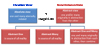
Christian Worldview
|
vs.
|
Atheist Worldview
|
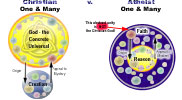
Van Til's
characterization of the Christian and non-Christian worldviews is a
radical challenge, a virtual Copernican Revolution, to the
understanding of religion that dominates modern culture. It is
common to hear in our day that faith and reason are mutually exclusive
areas of life. The famous Marxist evolutionist Stephen Jay Gould
of Harvard called it the doctrine of NOMA, or non-overlapping
magisteria ("magisteria" means teaching authority). "The net of science covers the empirical universe: what is it made of (fact) and
why does it work this way (theory). The net of religion extends over questions
of moral meaning and value. These two magisteria do not overlap. . . . To cite the arch cliches, we get the age of rocks, and
religion retains the rock of ages; we study how the heavens go, and they
determine how to go to heaven." (Gould, "Nonoverlapping Magisteria") Gould's essay is focused on science but this division of authority is often conceived more broadly as the distinction between reason and faith. On this view, the realm of
reason has no need of, and cannot co-exist with, divine authority.
Reason is the realm of science, politics, law, and objectivity.
Faith is the realm of the non-rational, emotion and pure
subjectivity. Thus a person
can, and should, participate in the rational areas of life without any
concrete direction from God. A person operating in the realm of
reason can rely on God for emotional support, for a "sense of purpose,"
but that is all.
This means that as human reason advances, the need
for faith should diminish. Faith is an explanation for things
that reason cannot explain. Faith was more needed when man was
more primitive and faced a world of overwhelming mystery and
terror. Freud taught that the origin of the idea of God is as a
projection of primitive human minds that a loving father was in control
of the fearful mysteries of the universe in order to give comfort to
those primitive people. But as human reason advances, the need
for
God should fade away like the smile on the Cheshire Cat.
Framed in such a manner, the issue of the truth of
Christianity versus atheism is a simple one. Atheism is the
rational belief and Christianity is devoid of rationality, because
reason has been defined to
exclude faith. End of discussion.
But that was too easy. Who came up with the
definition? The definition of faith as a leap beyond reason makes sense in terms of the atheist
worldview
because in that view an
Absolute Mind is denied, making the world ultimately
non-rational. The ultimate mind in the
universe is the finite human mind (or maybe a finite alien mind); thus anything beyond the finite human mind is beyond reason. This means that the argument above for atheism begs
the question of atheism. When Freud characterizes
religion as a leap beyond reason, he
is describing the irrationalism that is inherent in the atheist
worldview because irrationalism is ultimate in the atheist worldview. Faith that is a leap beyond reason is atheist
spirituality, not Christian spirituality! Freud assumes
the materialistic evolutionary worldview when he describes primitive
human consciousness emerging through purely non-conscious, non-rational, materialistic evolutionary forces. He assumes rather than proves that human minds thinking about God and the forces beyond their control are thinking about the non-rational realm from which their minds emerged, and thus are only self-delusionally God-dependant.
The Christian faith in things beyond human reason is not
an appeal to the non-rational but to the absolutely rational. The
Christian trusts in God, who is absolutely rational and is sovereign
over all that exists. Humans are created in the image of God;
thus they originally exist in personal relationship with God, not
inventing the idea of God to make up for their ignorance.
Christianity represents the dominion of the Logos (John 1:1), the
Word, the Reason.
With this understanding, the tables are turned on the
atheist. The debate between atheism versus Christianity is not a
matter of reason versus faith. As Cornelius Van Til points out in
the quote above, the debate is between a worldview in which the
non-rational is ultimate (atheism) and a worldview in which the
rational is ultimate (Christianity). There is a formal similarity between
the two worldviews. Both include an appeal to faith, mystery and
spirituality; but these similar words hide a substantial difference
between the two—that the atheist is expressing belief in an
ultimately non-rational universe when he uses these words, and the
Christian is expressing belief in an ultimately rational universe.
With the atheist view that the finite mind of man is the ultimate mind in the universe, the universe becomes philosophically anthropocentric (and geocentric, since humans live on earth). As Copernicus overturned the geocentric view with the heliocentric view, Van Til has overturned the atheist view that man's mind is autonomous
with the view that God's mind is autonomous. The universe is theocentric
rather than anthropocentric.
Atheists, Polytheists, and Arminians as Fellow Believers in Naturalism
"Atheism" here does not exclude other intelligent beings in the universe, whether they be space aliens or Greek gods. The worldview of Greek mythology can be called "atheistic" or "naturalistic" because ultimate reality is impersonal - not a personal God. Chaos or some material substance was the ultimate source of existence that
gave birth to
gods according to Greek mythology. While they may differ on epistemology, there is a significant philosophical agreement between those who believe in intelligent but finite gods and those who believe in only intelligent finite humans because both views affirm an ultimately impersonal, non-rational world. In either case, they share the same fundamental philosophical problem - explaining how the rational and moral arose in an ultimately non-rational, amoral universe.
This shows that atheists have a superficial understanding of theism, atheism and polythiesm when they claim that monotheists deny all gods but one and they are just taking the logic of monotheism one step further by denying all gods. The picture they paint is of a continuum with atheism on one end, montheism in the middle, and polytheism on the other end of the continuum. But atheism and polytheism should
be seen as different
varieties of
naturalism. The latter just has a more robust imagination. In terms of philosophy of ethics, a human concensus as the ultimate source of ethics, as atheists often tout, is no better than the council of gods touted by Euthyphro. (See here for more on Plato's Euthyphro.)

|

|
|

|
|
Christian Worldview
|
vs.
|
Atheist Worldview
|
Even schools of Chrisitan theology that are considered conservative can be included in the "atheist" worldview as Van Til has divided the intellectual landscape here. If God's absolute soveriegnty is denied, that is, a denial that everything that happens in history happens according to God's eternally predetermined plan, then God's rationality
is not ultimate. God
becomes finite, and some
impersonal principle outside of God
originally determines what happens in history. This would include the denial that God predestines who will be saved. (This answers the claim that Van Til's apologetic can only answer those who deny divine revelation. The nature of the God who reveals is all-important.)
"Yet both Romanism and Arminian Protestantism leave the root assumption of the modern man untouched. And they leave this root assumption unchallenged because the root assumption
of their own theology partakes
in a measure of the root assumption of the foes of the Christian religion. Romanism, and in a lesser degree Arminianism, cannot challenge the heresy of those who worship and serve the creature more than the Creator because they themselves are not willing to serve the Creator exclusively. Only in the Reformed Faith is full justice done to the idea that man is the creature of God and that he must therefore live exclusively by the revelation of God."
-- The Intellectual
Challenge of the Gospel (Phillipsburg, NJ: Presbyterian and
Reformed Publishing Co., 1980), p. 19.
"The main point that we are concerned to make in this section is that Arminians, though in distinction from Roman Catholics they claim to stand firm upon the Bible as the final revelation of God, are yet unable
to challenge effectively the methodology of modern man. Their doctrine of free will makes them a ready prey to the modern notion of contingency. Their refusal to accept the doctrine of the all-controlling plan of God is itself of a rationalistic character; it assumes that that cannot be true which man cannot penetrate exhaustively by logic. Thus it is to be expected that they will also fall prey to the modern idea of rationalism."
-- The Intellectual Challenge of the Gospel (Phillipsburg, NJ: Presbyterian and
Reformed Publishing Co., 1980), p. 23.
One Circle People v. Two Circle People

|
This
shows how Van Til would diagram the
Christian and non-Christian worldviews in his class lectures, as a
former student recounts:
"Van
Til . . . always taught that a Christian worldview
should
be represented by two circles
(for Creator and creature), clearly distinct from one another, with the
larger one (representing God) on top. One circle alone referred to the
non-Christian worldview, in which man and God (if he exists) are on the
same level, part of one reality."
-- John Frame, Cornelius
Van Til: An Analysis of His Thought, (Phillipsburg,
NJ: Presbyterian and Reformed Publishing, 1995), p. 27.
|
If a person believes in a god, but that god is subject to the forces of history or something else beyond itself (like the god of modern process theology), then that is a one-circle worldview no less than atheism.

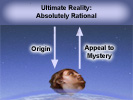
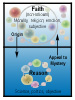
We can
add more detail to
Van Til's chalkboard diagrams based on his
vivid illustrations of the atheist worldview in his writings. In
the atheist's circle I have added an island of reason that has arisen
out of the bottomless and shoreless sea of an ultimately non-rational
universe:

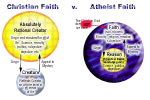
The grids in the
these diagrams represent rational
structure. The Christian worldview begins with a triune God who
is absolutely rational; and He creates a rational world. "Reason"
in the atheist worldview is depicted as similar to the Christian God in
these diagrams because the atheist claims that the human mind is
autonomous, as Christians claim for God. The atheist says that
the only autonomous minds are finite human minds. There is no
autonomous Absolute Mind. Thus any rational structure in the
world is imposed by the human mind. The human mind is a finite
island of rational structure that floats in the dark, meaningless ocean
of an ultimately non-rational world. There is a formal
similarity between the two worldviews in that in both there is an
acknowledgment by humans of a mystery that is greater than the human
mind, and the human mind originates from that realm of mystery.
But the similarities should not blind one to the profound difference
between the worldviews: The
Christian appeal to mystery is an appeal to an ultimate rationality,
while the non-Christian appeal to mystery is an appeal to an ultimate
non-rationality. Atheist faith and Christian faith are
formally similar, but substantively different.
Here are
samples
of Van Til's illustrations on which the above
diagrams are based:
Non-Christian
worldview: An
island of human rationality in a shoreless sea of pure contingency:
"The
Pragmatist
thinks it quite possible to ask: 'Who made God?' Back
of God lies mere possibility. Possibility is a wider concept than
actuality. God and man both dwell on the island called Reality. This
island is surrounded by a shoreless and bottomless ocean of possibility
and the rationality that God and we enjoy is born of chance. The Theist
thinks it impossible to ask: 'Who made God?' God is for him the source
of possibility: actuality is a wider concept than possibility. The
little island on which we dwell rests upon the ocean of the reality of
God; our rationality rests upon the rationality of God. Pragmatism
maintains a thorough metaphysical relativism, while Theism will not
compromise on the conception of God as a self-conscious absolute
personality."
-- Christianity
and Idealism (Philadelphia, PA: Presbyterian and
Reformed Publishing Co., 1955), p. 8.
"Kant’s
phenomenal realm is but an island, and that a floating island
on a bottomless and shoreless sea. After all, the human mind can
furnish at most a finite schematism or a priori. We do not admit that
the human mind can furnish any a priori at all unless it is related to
God. But suppose for a moment that it could, such a schematism could
never be comprehensive."
--
Christian-Theistic Evidences
(Phillipsburg, NJ: Presbyterian and
Reformed Publishing Co., 1978), p. 37.
"It
is upon the
basis of this presupposition alone, the Reformed Faith
holds, that predication of any sort at any point has relevance and
meaning. If we may not presuppose such an 'antecedent' Being, man finds
his speck of rationality to be swimming as a mud-ball in a bottomless
and shoreless ocean."
-- Christianity
and Idealism (Philadelphia, PA: Presbyterian and
Reformed Publishing Co., 1955), p. 138.
"Modern
science
boldly asks for a criterion of meaning when one speaks
to him of Christ. He assumes that he himself has a criterion, a
principle of verification and of falsification, by which he can
establish for himself a self-supporting island floating on a shoreless
sea. But when he is asked to show his criterion as it functions in
experience, every fact is indeterminate, lost in darkness; no one can
identify a single fact, and all logic is like a sun that is always
behind the clouds."
-- Christian-Theistic Evidences
(Phillipsburg, NJ: Presbyterian and
Reformed Publishing Co., 1978), pp. 147-48.
"In the case of Kant the application of the law of contradiction to the facts of space and time results in the reduction of the body of scientific knowledge to something that resembles a floating island of ice on an infinitely deep and extended boiling cauldron of change."
-- Christianity in Conflict (Philadelphia: Westminster Theological Seminary, 1995 [1962]), p. 118.
Or
human reason as a clearing in an
infinite forest:
"If
we compare
the realm of the phenomenal as it has been ordered by
the autonomous intellect to a clearing in a large forest we may compare
the realm of the noumenal to that part of the same forest which has not
yet been laid under contribution by the intellect. The realm of mystery
is on this basis simply the realm of that which is not yet known.
And
the service of irrationalism to rationalism may be compared to that of
some bold huntsman in the woods who keeps all lions and tigers away
from the clearing. This bold huntsman covers the whole of the
infinitely extended forest ever keeping away all danger from the
clearing. This irrationalistic Robin Hood is so much of a rationalist
that he virtually makes a universal negative statement about what can
happen in all future time. In the secret treaty spoken of he has
assured the intellect of the autonomous man that the God of
Christianity cannot possibly exist and that no man therefore need to
fear the coming of a judgment. If the whole course of history is,
at least in part, controlled by chance, then there is no danger that
the autonomous man will ever meet with the claims of authority as the
Protestant believes in it. For the notion of authority is but the
expression of the idea that God by his counsel controls all things that
happen in the course of history."
-- The Defense
of the Faith (Philadelphia, PA:
Presbyterian and
Reformed Publishing Co., 1955), p. 143.
Many atheists may disagree with some aspects of the
characterization of atheism in the above diagram. In particular,
they may dispute that they believe that the non-rational should be
equated with the subjective rather than being associated with science
and objectivity. It should be noted that Van Til believes Kant's
philosophy to be one of the most logically consistent with the
atheistic presupposition of the autonomy of the human mind, so the
diagram most accurately reflects Kantian atheism. Atheists who
believe that there is an objectively knowable world beyond what the
human mind has rationalized are borrowing from the Christian worldview
rather than being as consistent with the idea of human autonomy as Kant
was in declaring things-in-themselves to be unknowable.
The
One and the Many
Van Til
also often explained the difference between Christian and non-Christian
worldviews in terms of the One and the Many:

|
Particulars and
universals are eternally related in God. Creation is a finite
reflection of God.
|
v. |
Allegedly, a string
with no ends (unity abstracted from all particulars) combines with
beads with no holes (particulars abstracted from all unity) to create
the intelligible world.
|
The non-Christian
assumes that unity and diversity, law and fact, are originally
independent of each other. The universe furnishes the diversity,
and the mind furnishes the unity. But each apart from the other cannot
be an object of knowledge; they amount to chaos (particulars with no
unity) and a blank (unity with no diversity). Either way, the
irrational is ultimate. And these two irrational elements cannot
come into positive relation and create rationality because, by
hypothesis, they exclude each other—as if one tried to string beads
without holes onto a string with no ends.
The
Christian view is that God is the source of all unity and diversity,
all laws and all facts. The One and the Many never exist in
complete abstraction from each other. God is an eternally
existing "concrete universal." God's
plan for the world is comprehensive of all individual facts that ever
exist. He is omniscient. The absolutely rational is
ultimate.
"[I]t
may be said that for the human mind to know any fact truly, it must
presuppose the existence of God and his plan for the universe. If we
wish to know the facts of this world, we must relate these facts to
laws. That is, in every knowledge transaction, we must bring the
particulars of our experience into relation with universals. So, for
instance, we speak of the phenomena of physics as acting in accordance
with the laws of gravitation. We may speak of this law of gravitation
as a universal. In a similar way, if we study history instead of
nature, that is, if we study the particulars of this world as they are
related to one another in time as well as in space, we observe certain
historical laws. But the most comprehensive interpretation that we can
give of the facts by connecting the particulars and the universals that
together constitute the universe leaves our knowledge at loose ends,
unless we may presuppose God back of this world. . . . As
Christians,
we hold that in this universe we deal with a derivative one and many,
which can be brought into fruitful relation with one another because,
back of both, we have in God the original One and Many. If we are to
have coherence in our experience, there must be a correspondence of our
experience to the eternally coherent experience of God. Human knowledge
ultimately rests upon the internal coherence within the Godhead; our
knowledge rests upon the ontological Trinity as its presupposition."
-- An
Introduction to Systematic Theology (Phillipsburg, NJ: Presbyterian and
Reformed Publishing Co., 1974), pp. 22-23.
"If then, on Kant’s basis; science
is to be saved from having to do with, on the one hand, an infinite
number of unrelated particulars—like beads that have no holes in them
and, on the other hand, having to do with pure abstract logic—like an
infinitely long string which has no ends and certainly no end that can
be found by man—then science must be saved by this very same man who
does not understand himself and who never will understand himself."
-- The Protestant
Doctrine of Scripture (Phillipsburg, NJ: Presbyterian and
Reformed Publishing Co., 1968), p. 17.
"A scientific method not based on
the presupposition of the truth of the Christian story is like an
effort to string an infinite number of beads, no two of which have
holes in them, by means of a string of infinite length, neither end of
which can be found."
-- The Protestant
Doctrine of Scripture (Phillipsburg, NJ: Presbyterian and
Reformed Publishing Co., 1968), p. 2.
"[A]ccording to all non-theistic
thinking, the facts and the laws
that are supposed to bind the facts together into unity are first
thought of as existing independently of one another and are afterward
patched together. It is taken for granted that the temporal is the
ultimate source of diversity. Accordingly, Reality is said to be
essentially synthetic. The real starting point is then an ultimate
plurality. And an ultimate plurality without an equally ultimate unity
will forever remain a plurality. It is this that is especially apparent
in all forms of pragmatic thought."
-- A Survey of Christian
Epistemology (Phillipsburg,
NJ: Presbyterian and
Reformed Publishing Co., 1969), p. 217.
There are two basic options regarding the One and the Many: 1) The One and the Many are eternally related (the Christian/Biblical view), or 2) they are not, meaning the One and/or the Many exists in abstraction from the other. This second choice allows three possible alternatives: 1) Only the One exists; no divesity exists. 2) Only the Many exists; there
is no unity. Or
3) the
One and the Many originally exist in abstraction from each other, and then combine to form the intelligible world. The Christian view begins with an intelligible world, or more precisely an absolutely rational triune God who creates the world. The non-Christian view begins with the unintelligible, and can only end there.
While innumerable different beliefs can be appended to either the Absolute view of the Abstract view, for the issue of the original relation of the One to the Many, this covers all the possibilities. In terms of this issue the "impossibility of the contrary" can be established. The Absolute view allows for the possibility of knowledge. The Abstract view does not. And there are no other options on this issue.
In
other words, the nature of God as He eternally relates the One and the Many to each other and all doctrines that are logically entailed by that are established as necessarily true by the transcendental argument. Other aspects of God's nature and other doctrines of man, the world, and salvation have to be specially revealed by God. Empirical proofs are part of the verification of whether they are revelations truly from God, and thus that the content of any particular revelation
is true (e.g. miracles and/or fulfilled prophecy accompanying the revelation). For more on this, see my essay, "The Scope and Limits of Van Til's Transcendental Argument: A Response to John Frame"
Since the Abstract view asserts an ultimately impersonal universe, and this ultimate authority is mute since it is impersonal. Man becomes the ultimate being who speaks; therefore, man becomes, for all practicle purposes, the ultimate authority in such a worldview. The rebel against God asserts the ultimate impersonalism of the universe in order to assert his own ultimate, autonomous authority. Thus the two views can
be described as asserting God as the ultimate authority versus asserting Man as the ultimate authority.
Two Basic Views with Three Non-Christian Varients

Only two basic views:
"There
is no other alternative, as far as theories of reality are concerned,
than that between Christianity which regards man as a creature of God, and non-Christian thought which regards man as a product of impersonal forces in a universe that is somehow, accidentally, here."
-- Christian Theistic Ethics (Phillipsburg, NJ: Presbyterian and
Reformed Publishing Co., 1980), p. 71.
"However restricted the debate between the believer and the non-believer may be at any one time, there are always two world views ultimately at odds with one another. On the one side is a man who regards
himself
as being unable to find an intelligible interpretation of experience without reference to God as his Creator and to Christ as his Redeemer. On the other side is the man who is certain that he cannot find any such an interpretation. He assumes that there resides with him the power
to make a universal negative
statement about the nature of all reality."
-- The Protestant Doctrine of Scripture (Phillipsburg, NJ: Presbyterian and
Reformed Publishing Co., 1968), pp. 5-6.
"We are now prepared to state the issue between the basic principle of interpretation of human life and experience that thus comes to expression in modern theology, philosophy and science and that which comes
to
expression in the idea of an infallible Bible as set forth by Warfield. That issue may be stated simply and comprehensively by saying that in the Christian view of things it is the self-contained God who is the final point of reference while in the case of the modern view it is the
would-be self-contained
man who is the final point of reference in all interpretation."
-- "Introduction" to B. B. Warfield, The Inspiration and Authorityof the Bible (Phillipsburg, NJ: The Presbyterian and Reformed Publishing Company, 1948), p. 18.
"So then the situation is always mixed. In any one’s statement of personal philosophy there will be remnants of his
old man. In the case of the Christian this keeps him from being consistently Christian in his
philosophy of life and in his practice. In the case of the non-believer this keeps him from being fully Satanic in his opposition to God. But however true it is that non-Christians are always much better in their statements of philosophy and in their lives than their own principle would
lead us to expect
and however true it is that Christians are always much worse in the statement of their philosophy and in their lives than their principle would lead us to expect, it is none the less also true that in principle there axe two mutually exclusive systems, based upon two mutually exclusive principles of interpretation."
-- "Introduction" to B. B. Warfield, The Inspiration and Authorityof the Bible (Phillipsburg, NJ: The Presbyterian and Reformed Publishing Company, 1948), pp. 24-25.
Three possible views from the negation of the absolute God:
"The third and last position of Plato mentioned in the preceding paragraph needs some further elucidation, because it represents the high-water mark of Plato’s thought and, we believe, has exhausted the possibilities of all antitheistic thought, whether ancient or modern.
"This third position of Plato was the result of the recognition that the acceptance of either the first or the second position would involve the acceptance of an abstract method of reasoning, which Plato was most anxious to avoid. It was impossible to approach the whole of truth if one should reason on the basis of empirical facts only. On the other hand, one could never seek to account for the reality of the world of senses (sensuous world), if
one would limit his knowledge to the standard of the Ideal world only. These could not be kept separate. And what was most important, Plato had the true insight that unless one could relate the two worlds in one comprehensive scheme of knowledge, one could not expect to know anything about either of the two worlds. He felt that in the human soul the two worlds were somehow united, and one would have to understand this union to understand either the soul itself or anything else. . .
"Plato was glad to admit that his argument was abstract when he was at his first and second positions. But we must now observe that his thought had not lost any of its abstract character even when he maintained his third position. Plato’s logic remained an either or affair. An ultimate interdependence of the categories of time and eternity leads to just the same abstraction as that to which an ultimate independence of these categories leads.
The reason for this is that an ultimate interdependence eventually amounts to a victory of the one type of category over the other. Plato could not stop his ice cubes from becoming water unless he would freeze all the water into ice. Or, to use the marriage illustration once more, there was harmony 'ever after' because the husband never disputed the wife’s opinions but took them for granted as final authority."
-- A Survey of Christian Epistemology (Phillipsburg, NJ: The Presbyterian and Reformed Publishing Company, 1969), .pp. 38, 42-43
"If the abstract
rationalist principle of continuity were to be taken by itself, it would obviously destroy all individuality and all history, and therewith all human predication. To prevent this calamity, apostate
thought
employs the irrationalist principle of discontinuity. By means of it, as correlative to form, the reality of time, of change and therefore of history, is supposed to be preserved. But if the principle of pure discontinuity were employed by itself, it would destroy all rational connection between the facts of time. And human predication would cease once more.
"To prevent the calamity of the destruction of human predication by the exclusive use of either the principle of pure form or pure matter, the two principles
are put into correlativity with one another.
"Will this idea of the correlativity between an abstract or formal principle of continuity, and an equally abstract principle of discontinuity, save
human predication? The answer must be in the negative. Each of the two principles are, in the nature of the case, destructive of one another. Each claims the whole of reality exclusively for itself. Nowhere can the contact between them be that of supplementation. On the contrary, any contact must always be that of
a death-struggle."
-- Christianity and Barthianism
(Phillipsburg, NJ: Presbyterian and
Reformed Publishing Co., 1962), pp. 204-05.
"[Calvinists] offer an interpretation of life in its totality on the basis of the principle Scripture offers. That principle is the ontological trinity. In answer to
his challenge, we would tell
Gilson that, unless he is willing with us to interpret nature and all things
else in terms of the ontological trinity, he can get no meaning into human
experience. The interpretations of the natural reason, made by the aid of
abstract principles and brute facts can, in the nature of the case, lead with
rationalism (Parmenides) into a universal validity that is empty of content, or
with empiricism (Heraclitus) to a particularism that has no universality, or to
a phenomenalism that is a compromise between these two positions and shares the
weaknesses of both."
-- Common
Grace and the Gospel
(Phillipsburg, NJ: Presbyterian and
Reformed Publishing Co., 1972), pp. 63-64.
"There seems to be no escape from the consequence that 'God' must be (a) one of the members of the pluralistic
universe
in which case he is finite,
or (b) the universal nature within the members of the Pluralism in which case this transcendence has disappeared, or (c) the combination of these in which case God is identified with the Universe or Whole, so that there is no more need of speaking of 'God' at all."
-- Christianity and Idealism (Phillipsburg, NJ: Presbyterian and
Reformed Publishing Co., 1955), pp. 22-23.
The Great Chain of Being
|

|
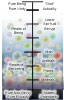
The
Greeks often expressed their view of the world in terms of the Great
Chain of Being. The concept was brought into Christian theology
through Thomas Aquinas, as well as others who tried to combine Greek
philosophy with Christian theology. Here I have illustrated the
relationship between the Great Chain of Being and the Greek view of the
One and the Many. Pure being, which is also pure unity, is at the
top
of the chain. Pure non-being, out of which arises matter, the
principle of diversity, is at the bottom of the chain. Diversity
dissolves and unity increases the higher up the chain of being, until a
pure blank is reached at the top. Man is in the middle, pulled in
two
directions. He has a material body from below, but a soul from
above;
and the soul yearns to escape from matter into the pure unity from
which it originated. This has something of a Christian sound to
it when
God is equated with the One; but this One is a pure blank, an empty
concept, not the living, historically active God of Abraham, Isaac and Jacob. Also,
this
view denies the Creator-creature
distinction because man's soul is one being with God; and it poses
an irresolvable dialectic tension between the one and the many, which
undermines the possibility of human knowledge.
|
"Arthur Lovejoy
speaks
of this hierarchy as The Great Chain
of Being. Lovejoy points out
the internal contradiction that lies at the heart of this idea. On the
one hand, the world of the Absolute is said to be wholly other than the
world here below. The idea of the Absolute is obtained by the process
of negation. The Absolute is therefore a timeless, static something of
which man can only say that it is not
this and not that. On the
other
hand, the Absolute is thought to be the originating source of all that
takes place in our world of change."
-- The Great Debate Today
(Nutley, NJ: Presbyterian and
Reformed Publishing Co., 1971), pp. 22-23.
"The Thomistic notion of the mind
of man as potentially participating in
the mind of God, leads to an impersonal principle that is purely
formal, and as such is correlative to brute factual material of a
non-rational sort. It follows that it is only by abstraction from
individuality that the facts can be known. The whole scheme of the
philosophy of nature is made into a 'Chain of Being' idea, fitted
into a pattern of ever-increasing universality. Inasmuch as anything is
higher in the scale of being than something else, it is to that extent
less individual. All knowledge is of universals. And, as already
observed, it is the mind conceived of as ultimate and as correlative to
these facts, that has to abstract from particularity in order to know
them."
-- The Reformed Pastor and Modern Thought
(Phillipsburg, NJ: Presbyterian and
Reformed Publishing Co., 1980 [1971]), pp. 89-90.
"The Greek view appears clearly in
the philosophy of Plotinus, the last of the great Greek thinkers. On
the view of Plotinus man as an individual hovers between a world of
pure abstract rationality and a world of pure abstract non-being or
contingency. To be himself, man must, on this view, be constantly torn
in opposite directions. He is drawn upward toward pure rationality,
lest his individuality, derived as it is from pure non-being, lead to
his annihilation. But he is, at the same time, drawn down toward
non-being, lest his individuality be swallowed up into abstract
impersonal rationality and he thereby lose his identity."
-- Is God Dead? (Philadelphia, PA: Presbyterian and
Reformed Publishing Co., 1966), 3.A.
"I know what the analogical being
of Aristotle is. I know that it is
based on a supposed interaction of pure form and pure matter on a
continuum of levels, a chain of being. I know that, with his idea of
being as analogical, Aristotle tried to mediate between the abstract
eternal essences of Plato’s thought and the utterly unrelated
particularism of Sophistic thought. I know that the effort of
Aristotle was a failure. His lowest species was still of the same
nature as was the highest essence of Plato. For Aristotle, as well as
for Plato, knowledge is of universals only. Aristotle’s could
do nothing but drift on a bottomless and shoreless ocean of chance that
was pure matter. Holding firmly with Plato and with Parmenides to the
adequation of thought and being, Aristotle was unable, for all his
supposed empiricism, to attribute any significance to history and its
individuality."
-- The Reformed Pastor and Modern Thought
(Phillipsburg, NJ: Presbyterian and
Reformed Publishing Co., 1980 [1971]), p. 217.
"Evil is thus
mere negation, non-moral in character, found as it is within the realm
of those things that are possibles by the law of logic. It is by making
of man a moral amoeba near the bottom of the scale of being that Thomas
hopes to escape the charge of determinism. It is by thinking of the
will of God as pure identification with abstract rationality, and by
making man’s will the principle of moral indeterminacy, and then
bringing both of these concepts to bear upon the moral acts of man that
Thomas hopes to escape both determinism and indeterminism. If, when
deciding to act morally, man places before himself the ideal of the
vision of deity, he will more and more participate in the being of God.
And on his part, God, by spreading abroad his goodness widely but
thinly at the bottom of reality and more narrowly and heavily toward
the top of reality, opens the way of opportunity for man to approach
God himself in intensity of being and goodness, and enables man to do
what of himself without such grace he could not do. . . .
"Looking at the
doctrine of the will in man as Thomas develops it, we see at once that
real freedom for him is absence of being. On the other hand, nothing
but being can be a cause of anything. “But only good can be a cause,
because nothing can be a cause unless it is a being, and every being as
such, is good.” * To the extent that man has being he
participates in the being of God and as such is good. According to the
extent that he has being, man may be said with God to be the giver of
the rule, the lawgiver. Here again is the principle that the moment the
individual speaks, this individual has lost his individuality."
-- The Reformed Pastor and Modern Thought
(Phillipsburg, NJ: Presbyterian and
Reformed Publishing Co., 1980 [1971]), pp. 102 & 104. * Summa
Theologica,
I, Q.49, A.1.
The
Faith - Reason Two Story House
|

|
The
foremost theologian of the Roman Catholic Church, Thomas Aquinas, held
to a distinction between faith and reason that is often expressed as a
two-story house. Reason is the first level. It is a realm of
religiously neutral common ground shared between the
Christian and the non-Christian. On top of this
religiously neutral
first story the Christian adds the second story of faith. Aquinas
said
that the knowledge of God is an area of reason, common between the
Christian and non-Christian. His philosophical evidence for
this was
Greek philosophers who taught that an abstract principle of reason,
called the "unmoved mover" by Aristotle, provided the source of unity
for the world. Because this universal being was achieved by
excluding
all plurality, the universal being has no content. Aquinas said,
therefore, that by means of reason we can know that God exists, but not
the
nature of
God. Faith in supernatural revelation tells us the nature of
God.
Kant pressed this abstraction of the one and the many to its
logical conclusion and said that we cannot not know God at all, because
there
is nothing to know about a concept without content. Neither can
there
be propositional revelation from God because it would have no
content.
"Concepts
without percepts are empty," Kant famously said. On Kant's
view,
religion is not rationally meaningful; it is only emotionally
meaningful. Only an absolutely rational God escapes Kant's
criticism—a God who is the source of all the diversity in life as
well as all unity, one who is a concrete universal, not an abstract
universal. There is no religiously neutral lower story. All
ground is God's ground. All of life is religious. Nothing
is secular, except as a false interpretation of life.
|
"All too often it has been
presented as though there is, first of all, that which Christianity has
in common with all non-Christian ethics, and then there are special
requirements that pertain to Christianity alone. The first may be
spoken of as the first story of a house. So Roman Catholicism argues as
though Christianity took the four cardinal virtues of Greek ethics as a
first story, and merely added to it the three virtues of love, hope,
and faith as a second story. But this is not true. The structure of
Christian ethics is something that is different from all other systems
of ethics. The first story of Christian ethics is built of different
material from that of which non-Christian ethics is built, as well as
is the second story. And it is to the difference of the first story
that we must turn first. . . . This difference is clear as far as the
standard of ethics is concerned if only we keep in mind that, according
to Christian ethics, the moral consciousness of man has never
functioned apart from God, while according to all non-Christian ethics,
the moral consciousness has always functioned apart from God."
--
Christian-Theistic Ethics
(Phillipsburg, NJ: Presbyterian and
Reformed Publishing Co., 1980), pp. 127-28.
"Looking
back we recall that we started our discussion of the Protestant
doctrine of Scripture by an analysis of the views of Warfield and of
Bavinck. Both men view the place of Scripture as imbedded in their
total outlook on life. They do not build the first story of their house
by reason in order then to add a second story built by faith. Their
outlook on life is a living whole. For convenience we speak of this
total outlook on reality as a world and life view."
--
The Protestant
Doctrine of Scripture (Phillipsburg, NJ: Presbyterian and
Reformed Publishing Co., 1968), p. 103.
"How
then is the Christian believer to proceed as he seeks to win sinners to
accept the Christian point of view? Roman Catholicism answers
this question as follows. . . . Christians must offer their own
position as something additional to what the non-Christian already
believes. The Christian must tell the non-Christian that there is no
defect in what he says about life but that he has not said enough. The
Christian must tell the non-Christian that he has only half of the
orange and that Christianity has the whole orange. On this view
Christianity is presented as though it were the second story of a
house, the first story of which has already been built and built well,
by the Greeks."
--
"Scripture
And Reformed Apologetics," from The
New Testament Student and
Theology, edited by John H. Skilton (Nutley, NJ:
Presbyterian
and Reformed, 1976), 3:150–59.
"On
the other hand faith for Kant pertains to what he calls 'the noumenal
realm.' Of that realm man cannot intellectually know anything. If there
is to be any contact with what is in that realm, it must be by
irrational or non-rational means. In general, it is said to be faith by
which we know what is there. And God is said to be there. But then the
God who is there is indeterminate. The contact between the two realms
is, from both directions, a partially rationalist and partially
irrationalist affair. The idea that God has made man in his image, that
Adam at the beginning of history knew God by direct revelation in his
own constitution and in his environment as well as by direct
communication is, on this basis, impossible. Nothing that happens in
history, on the days and weeks and years of the calendar, can bear a
direct revelation of God. The Son of God cannot come into history on a
certain day and die or be raised from the dead on a certain day in
ordinary history and thereby effect the reconciliation of man to God."
--
The Theology of James Daane
(Philadelphia: Presbyterian and
Reformed, 1959), Ch.4, § 5.
Taking in Each Other's Washing

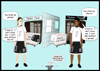
Since both unity and diversity are necessary for knowledge, the rationalist and the irrationalist refute each other, and they must steal from each other. They both can point out that the other needs what he has to make his opponent's view reasonable; and they each must surreptitiously make use of the other one's principle in some way in order to make each of their own views
have some appearance of being reasonable.
The phrase "taking in each other's washing" had been used by Mark Twain and others before Van Til to mean that people can't earn a living washing each other's dirty clothes - just swapping dirty laundry, washing it and then swapping back. They make a show of being economically productive but are not really making any progress. That applies to the issue of the rationalists and irrationalists in that they may have an appearance of making
sense of human knowledge and reason but are not really making progress toward that goal by borrowing the ideas of their opponent within their anti-theistic worldview. My cartoon of athletes taking the article of clothing that they are missing from their outfit goes beyond the original saying, but it further illustrates Van Til's philosophical critique of unbelief.
"Naturally, Plato was 'helpful' when he pointed out to the Sophists that, if reality were subject to universal flux, then human predication would cease to have meaning, and that relativistic theories were generally proposed with a claim of absolute truthfulness. But then, having said this, it would have been well to investigate the other half, namely, that the Sophists were, of course, equally capable of refuting Plato. His highest law, the absolute universal,
was
a purely empty form. Whatever else was to be said of it, it had still to be made correlative to the idea of pure contingency. But by merely speaking, Plato became a relativist; thus, he took pure contingency into his pure absolute. As with the Sophists, he had to, if he spoke at all, contradict himself with every word. For appearances of justification in predicating on any subject, it thus behooved the Platonist and the Sophist to take in each other’s washing. Pure form and pure 'matter,' or pure contingency,
are correlatives of each other. Possibly, Christians throughout history would have an emotional preference for the idealist thinking of Platonism, as over against all forms of sophism, as well as mechanism, materialism and pragmatism before or since. But, as to logical priority, neither was able to “make peace with the law of contradiction,” i.e., neither one could offer a positive foundation upon which the law of contradiction might have been employed at all. Only the Christian position, with its teachings of
the triune God as the creator and redeemer of men, is the true starting-point for all argument without contradiction. Scepticism is defeated only by Christianity."
--
Who Do You Say That I Am? (Philadelphia: Presbyterian and
Reformed, 1975), p. 17.
"All non-Christian positions have equal rights with respect to one another just because none of them have any right to their views. If any of them are going to say anything definite
about any fact in this
world
in relation to
any other fact in this world, they must flatly contradict themselves in every sentence which they utter. They must use a static principle of continuity and a purely contingent principle of discontinuity in everything that they say about anything."
--. The Protestant Doctrine of Scripture (Phillipsburg, NJ: Presbyterian and
Reformed Publishing Co., 1968), p. 17.
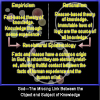
God - The Missing Link
A. Between the Object and Subject of Knowledge:
|

|
Denial of an absolute Creator results in the problem of explaining how the subject of knowledge (the human mind) and the object of knowledge (the facts of the external world) can work together to give the human thinker knowledge of facts. The history of philosphy has shown that philosophers vacilate between the view that facts speak for themselves, leading to a facts being
seen as isolated particulars without order,
or the mind of man is said to impose order on a less-than-real world of facts. The solution to the delimma is to see an absolutely rational Creator as the source of both individual facts and the concepts that man imputes to the facts, with the relationship between the two sides existing for all eternity in the mind of God. The following quote includes Van Til quoting Valentine Hepp, but it is an accurate reflection of Van Til's own view on this point and is a good way to describe Van Til's view:
|
"Hepp then turns to a criticism of these two alleged grounds of certainty. He raises objections to seeking the ground of certainty in the subject on the ground that subjectivism always leads to scepticism. Then he adds: 'Above all, however, to see the ground of certainty in the subject itself is in conflict with Christian principle. It leads, as we saw, to self-sufficiency of human thought. Just because
we are creatures we cannot in any sense, no more on the question of certainty than on any other question, be sufficient to ourselves.' In a similar manner, Hepp finds that certainty cannot be found by subjecting the subject of knowledge to the laws of the object. 'Thus there is a serious lack found in the field of epistemology. There is here a missing link.… Neither the subject nor the object can afford us the last ground for certainty.'
" If no ground for certainty is found in the creature it is reasonable that we should seek it in the Creator. Philosophy has to an extent been aware of this fact. Many idealist philosophers have recognized the necessity of the existence of God. They have virtually admitted that our certainty must rest on transcendent grounds. The only solution for the problem is the notion of the general testimony of the Spirit."
-- An Introduction to Systematic Theology (Phillipsburg, NJ: The Presbyterian and Reformed Publishing Company, 1979), p. 51.
"Our argument for the objectivity of knowledge with respect to the universe can never be complete and satisfactory unless we bring in the relation of both the object and the subject of knowledge to God. We may debate endlessly about psychological problems without fruitage if we refuse to bring in the metaphysical question of the nature of reality. If the Christian position with respect to creation, that is, with respect to the idea of the origin of both
the subject and the object of human knowledge is true, there is and must be objective knowledge. In that case the world of objects was made in order that the subject of knowledge, namely man, should interpret it under God. Without the interpretation of the universe by man to the glory of God the whole world would be meaningless. The subject and the object are therefore adapted to one another. On the other hand if the Christian theory of creation by God is not true then we hold that there cannot be objective knowledge
of anything. In that case all things in this universe are unrelated and cannot be in fruitful contact with one another."
-- The Defense of the Faith (Philadelphia: The Presbyterian and Reformed Publishing Company, 1955), p. 60.
B. Between Law and Love in Ethics:
|

|
An abstract view of the one and the many has a similar effect on ethics as it does on epistemology. An absolute God is the missing link to bring the one and many together in a way that makes ethics possible. Obeying God's law has the best consequences in history and eternity because God controls both. God's law never becomes outdated because God rules
over history. Although
there is not perfect justice in history, God rewards and punishes in history in terms of obedience of disobedience to His law in a way that gives people, individually and corporately, time to repent or confirm their unrepentant rebellion. (I have used "love" here in the sense that is popular and that fits with how a utilitarian would view "love," as doing what has the best consequences for people regardless of what some "impersonal" law would say. Defined biblically,
love can be equated with law.
God commands love, and obeying God's commands results in the best consequences. Cf. Lev. 19:18, Matt. 7:12, Luke 10:25-37, Rom. 13:10.)
|
"We have indicated that all the contrasts between various schools of non-Christian ethics, such as those between intellectualistic and voluntaristic, between national and international, between individual and social, between selfish and altruistic, between happiness and goodness, between usefulness and virtue are all due to the assumed correlativity of God and man [i.e. that reality is bigger than God and man - the one circle view - M.W.]. This assumed
correlativity of God and man, this assumed denial of the creation doctrine, this assumed ultimacy of evil allows for no ethical ideal other than that of a give and take, of a “claims and counterclaims” between individuals who must live together and who yet must live at the expense of one another. . . . All forms of non-Christian ethics rest on the assumption that man has within himself the principle by which he can truly know himself, set the proper ideal for himself, and that he has the spiritual power
to make progress in working his way toward the realization of that ideal."
-- Christian Theistic Ethics (Phillipsburg, NJ.: The Presbyterian and Reformed Publishing Company, 1980), p. 72.
"It is well known that Kant has severely criticized Christianity’s conception of moral sanctions. He said that we intuit what is right and should obey the right, no matter what the consequences. We should not be good because we do not wish to go to hell or because we wish to go to heaven. This problem is immediately related to the question of the externality or the internality of the law. Kant claims,
and many after him claim, that if we have an internal conception of the moral standard instead of an external one, we shall live on a much higher plane. Much as a child has to be coaxed into being good by rewards or punishments, while a full grown man does the right because it is right, so many hold that Christianity’s conception of eternal weal or woe is indicative of a lower and earlier underdeveloped stage of ethical speculation.
"It is plain that if we may believe the Genesis account, God, at the beginning of history, began by offering to man a reward and by threatening punishment. The whole of Scripture is in perfect accord on this matter, from the earliest part to the latest part of the history of revelation. But we are now more directly concerned to point out that this Scripture principle is nothing but what we would expect if we were to try to work out a consistent theistic
scheme of interpretation. In the first place, the kingdom of God could not be envisaged in all its length and breadth without a special revelation with respect to it. Accordingly, God gave to man something of a vision into the remote consequences of his every ethical deed. Moreover, the rewards and the punishments were a part of the ethical program itself. It would simply be impossible for man to intuit ethical conceptions of right and wrong without seeing them in relation to rewards and punishments, because
these rewards and punishments had been made a part of the created ethical situation by God. Hence the attempt to intuit ethical laws without rewards and punishments is only another evidence of the persistent effort on the part of man to get God out of the picture. Still further, the reason why ethical laws were a part of the created ethical situation is that the whole created ethical situation was meant to be a finite replica of the infinite glory of God. If we separate the idea of rewards and punishment from
doing good or evil, it would mean that a man who did good might be rewarded with evil. And this would be contrary to the moral glory of God."
-- Christian Theistic Ethics (Phillipsburg, NJ.: The Presbyterian and Reformed Publishing Company, 1980), pp. 135-36.
A Transcendental Argument is Like a Diving Board
|

|
Hume said that all knowledge arises from experience. Kant replied that we should also accept that which is necessary for the possibility of experience, even though it is never experienced: "But though all of our knowledge begins with experience, it does not follow that it all arises out of experience" (Critique of Pure Reason, §B1). This type of argument is called a "transcendental argument." Kant's specific argument is that the autonomous human mind imposes order on experience
to make experience intelligible. Van Til
adopts Kant's transcendental type of argument, but rejects his specific claim, that the autonomous human mind can serve as a basis for
intelligible experience. Rather, starting with the autonomous, sovereign, self-sufficient Creator who is the source of both the unity and diversity of experience is necessary to account for the possibility of intelligible experience. But by "starting point" here, Van Til means the ultimate source of knowledge, that which must be presupposed to account for the possibility of knowledge. God is the ultimate starting point of knowledge. But he says that God is not
necessarily the proximate starting point.
We can deduce the necessity of God as the ultimate starting point from examining our proximate starting point - the facts of our experience. That should lead us to conclude that God exists.
|
"We cannot be too careful about asking what the starting point of any one’s argument is. It is of the utmost importance that we find our way through the maze of confusion that prevails on this subject.
"As a help to clarification of this subject we may perhaps suggest a distinction between an immediate and an ultimate starting point. By an immediate starting point is meant the place where the knowledge of facts must begin. It is of course quite consistent with a theistic position to say that we must start with the “facts” as that term is understood ordinarily. Neither Augustine nor Calvin would have objected to saying that knowledge of self was
their immediate and temporary starting point. But when the question of an ultimate starting point is raised the matter is different. In that case Augustine and Calvin would both have to say that their ultimate starting point is God. That is, they could intelligently think of their own non-existence but were unable to think intelligently of God’s nonexistence. The difference may perhaps be brought out by the analogy of a diving board. Suppose a diver was standing on the tip of a diving board and that all that
he could see of the diving board was the very tip on which he was standing. Suppose further that all that he could see around him was water. Now if he should say that the very spot from which he was about to make his leap is his starting point he might mean either of two things. If we thought of him as unaware of the connection of the point on which he was standing with the foundation on which it rested he would be speaking of that particular spot as the permanent or ultimate starting point. On the other hand,
if he were fully aware of the fact that the tip of the diving board is only a tip of a board that rests upon a solid rock under water, he might speak of that tip as a starting point but only as an immediate starting point. The real and ultimate starting point for him would be the foundation on which the whole diving board was resting. Similarly we may say that the question at issue is not that of what is the immediate starting point. All agree that the immediate starting point must be that of our everyday experience
and the “facts” that are most close at hand. But the charge we are making against so many Idealists as well as Pragmatists is that they are taking for granted certain temporal “facts” not only as a temporary but as an ultimate starting point. . . . Yet the very point in question is whether any statement can be made about any appearance at all without reference to the fact of God."
-- A Survey of Christian Epistemology (Phillipsburg, NJ: The Presbyterian and Reformed Publishing Company, 1969), pp. 119-21.
Or like beams under a floor:
"But the best and only possible proof for the existence of such a God is that his existence is required for the uniformity of nature and for the coherence of all things in the world. We cannot prove the existence of beams underneath a floor if by proof we mean that they must be ascertainable in the way that we can see the chairs and tables of the room. But the very idea of a floor as the support of tables and chairs requires the idea of beams that are underneath.
But there would be no floor if no beams were underneath. Thus there is absolutely certain prod for the existence of God and the truth of Christian theism. Even non-Christians presuppose its truth while they verbally reject it. They need to presuppose the truth of Christian theism in order to account for their own accomplishments."
-- The Defense of the Faith (Philadelphia: The Presbyterian and Reformed Publishing Company, 1955), p. 120.
Man made of Water Trying to Escape an Infinte Sea of Water
|

|
Van Til compares the atheist's attempt to explain human rationality to a man made of water attempting to escape from an infinite sea of water. Since the atheist universe is ultimately non-rational (the naturalistic worldview), the athiest cannot explain how humans could be rational. Specifically in terms of modern empiricism, which begins with changing sense
experience as the source of all knowledge, no unity can be found. The necessity that connects causes with effects is not itself a sensation. Even if, in Kantian fashion, the mind is said to impose order on the diversity of sense experience, that mind and the logical categories that it imposes are wholly products of the disorganized world of non-rational particulars.
|
"An illustration may indicate more clearly what is meant. Suppose we think of a man made of water in an infinitely extended and bottomless ocean of water. Desiring to get out of water, he makes a ladder of water. He sets this ladder upon the water and against the water and then attempts to climb out of the water. So hopeless and senseless a picture must be drawn of the natural man’s methodology based
as it is upon the assumption that time or chance is ultimate. On his assumption his own rationality is a product of chance. On his assumption even the laws of logic which he employs are products of chance. The rationality and purpose that he may be searching for are still bound to be products of chance. So then the Christian apologist, whose position requires him to hold that Christian theism is really true and as such must be taken as the presupposition which alone makes the acquisition of knowledge in any field
intelligible, must join his “friend” in his hopeless gyrations so as to point out to him that his efforts are always in vain.
"It will then appear that Christian theism, which was first rejected because of its supposed authoritarian character, is the only position which gives human reason a field for successful operation and a method of true progress in knowledge."
-- The Defense of the Faith (Philadelphia: The Presbyterian and Reformed Publishing Company, 1955), p. 119.
|